
Building San Antonio
Thomas E. Ewing
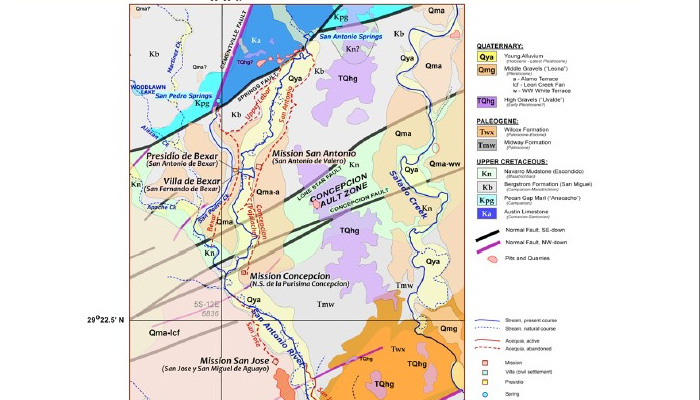
Before 1877 (the coming of the railroad), the building of permanent stone structures relied on local materials. In particular, three sources of stone were used in the mission structures of the 1700s, five 18th-century San Antonio missions that were recently declared a World Heritage Site. Austin limestone, a soft distinctive fine-grained (chalky) limestone with variable shell content, was quarried north of downtown near the two springs that provided fresh water for the early settlements. Limestone was used for decorative stone in the three northern missions, and may have been used for building stone in the northernmost mission, Mission San Antonio de Valero or 'The Alamo'. The same limestone was quarried for building stone in 19th-century downtown, notably the nave of San Fernando Cathedral (1874), St. Josephs Church (1868), and several other sites. A distinctive porous calcareous tufa (spring-deposited limestone) was quarried adjacent to Mission Concepcion and provided the main building material for both that mission and Mission San Jose. The tufa is unique in the rock record of the area; its extent and thickness are unknown. The tufa deposit occurs within the 'middle gravels' of Quaternary age, overlying mudstone of Late Cretaceous and possibly Paleocene age. The deposit occurs 1100 ft above the 'Bad Water Line' or downdip limit of fresh water in the Edwards Limestone, which may have provided artesian water to the 'Concepcion Spring'.The southern missions (San Juan Capistrano and San Francisco de Espada) did not use the same stone source. Instead, they used pisolitic gravel, mined from quarries in distal Quaternary fan deposits west of San Juan; and platy brown sandstone of the Wilcox Group, probably from the same quarry area. At Espada, the Midway mudstones were used to make bricks that are used in archways and other locations.

8620 N New Braunfels Ave. San Antonio, TX 78217
Copyright © South Texas Geological Society. All rights reserved.